
“In order to change a situation one must first see it for what it is” - James Baldwin, The Fire Next Time
Introducing a New Series
July 4th is the day many Americans will celebrate the Declaration of Independence. Whether they are progressives or conservatives, nationalists of all stripes will fervently engage in rituals of devotion. Words like freedom will hang on their lips. Many will credit the Founding Fathers for the freedom—however tenuous or vaguely defined—that we enjoy. Stories will be retold, perpetuating a sanitized image of the great nation to which they belong.
I empathize with such nationalistic sensibilities. We all want to feel that we belong somewhere and, more importantly, belong to something good and larger than ourselves. It is a very human desire. The problem is that stories are not politically neutral. How we tell the story of the communities to which we belong also determines who is included and excluded. The stories we tell will always privilege a certain standpoint over others—and that standpoint will either serve narrow interests or the common good.
Perhaps more crucially, the impulse to be good leads us to sanitize and distort the past because it is harder to look at ourselves honestly. It takes courage to look at our community in its fullness without flinching. That courage is needed more than ever as attempts to bury what is unfavorable in the past ramp up in schools and universities. By facing reality, we can shape the future responsibly.
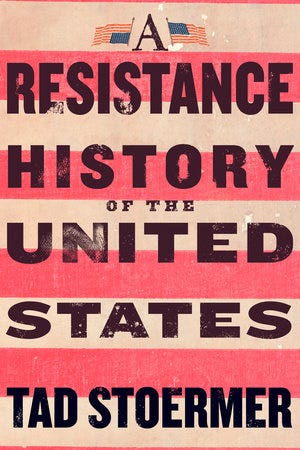
To help myself see the past more clearly, starting this July, I will post a series of reflections as I read Tad Stoermer’s A Resistance History of the United States. I have chosen Stoermer’s book because of its moral clarity and its questioning of conventional wisdom.
More valuably, it teases out the lessons the past can teach us about how we might fight for freedom and democracy today. After all, what use is history if it doesn’t move us into action to advance the cause of freedom and justice for all?
Each entry will provide a summary of a selected chapter, highlighting key points of the story Stoermer tells. I will then offer a short reflection on what spiritual and ethical lessons I took away from it.
Metacomet’s Resistance
The first story is about how a freedom fighter became a villain and how a genocidal racist became a hero.
One hundred and fourteen years before the Declaration of Independence, Metacomet became a Sachem of the Wampanoag—a confederation of Native American tribes—as the Plymouth settlers, the celebrated Mayflower pilgrims, continued to encroach on Wampanoag land. The Wampanoag and the Plymouth Pilgrims initially formed an alliance, but as the English population grew, the English pushed further onto Indigenous land. Meanwhile, the Pilgrims established the so-called “praying towns,” designed to reshape Indigenous people into compliant Christians who would renounce their culture and traditions.
At first, Metacomet advocated for his people through existing legal structures established by Plymouth authorities. But he soon discovered that the entire system was designed to favor the settlers, as one ruling after another affirmed the settlers’ rights over Indigenous land. In order to be heard, he realized, he had to act outside the legal structures to mount a more aggressive resistance. Metacomet began to form an alliance with other tribes.
Then came John Sassamon, a Christianized member of the Massachusett who had once served as Metacomet’s teacher and his father’s translator. Sassamon betrayed Metacomet by informing the Plymouth authorities of Metacomet’s intentions. Then he died under mysterious circumstances. The Plymouth authorities wasted no time, bypassing due process, in charging and executing three Wampanoag men for killing Sassamon based on questionable testimony. One of the three was Metacomet’s advisor.
Metacomet attacked an English settlement. The settlers retaliated with brutality, wiping out the resistance, destroying entire Indigenous communities, and mutilating Metacomet’s body. They displayed his head on a pole and sold his wife and son into slavery.
Stoermer claims that though Metacomet’s resistance ended, it forced the English to pay a heavy price for the abuse they inflicted. Metacomet was a freedom fighter for his people, but he was vilified by the English and colonial historians as an evil “savage.” Nationalist historians erased the brutal domination that the settlers inflicted on Indigenous peoples.
The Villain Becomes the Hero; the Hero Becomes the Villain
Nationalist history prefers to celebrate Nathaniel Bacon, a racist perpetrator of genocide, as an exemplar of freedom and the precursor of the 1776 Declaration of Independence.
When Bacon came to Virginia, tensions were already brewing between the Virginia settlers and Indigenous peoples. A planter, Thomas Mathew, stole from the Doeg. They raided Mathew’s farms in retaliation. Then the colonists struck back—against the wrong tribe. Later, John Washington launched another attack—also on the wrong tribe, the Susquehannock. Their chiefs surrendered, but that didn’t matter. Washington and his men slaughtered everyone anyway. Native American lives meant nothing to people like Washington.
On Stoermer’s account, Nathaniel Bacon’s chief complaint was that the colonists, under British rule, weren’t brutal enough. He protested their reluctance to wipe out Indigenous peoples by organizing his own militia. Then he went on a genocidal rampage—killing friendly and enemy tribes alike—including men, women, and children.
Bacon framed his genocidal campaigns as just resistance against his own “tyrannical” government and drafted a “Declaration of Independence,” the document that would later serve as a historical inspiration for Thomas Jefferson’s more famous version.
Needing a good story to support his nationalist agenda, Stoermer argues, Jefferson and other writers rehabilitated the legacy of a criminal against humanity as a freedom fighter and hero, while the real freedom fighters, like Metacomet, were vilified and erased from memory.
Stoermer writes:
“The American narrative conveniently erased the fact that Metacomet’s fight against colonial authority was a profound act of assertive resistance to protect an existing way of life from an abusive, encroaching power—precisely the kind of resistance the new nation claimed to champion, but only when waged by those it could define as their kind of American, and being white was a prerequisite.” (29)
Beware of False Prophets
Stoermer titled this chapter “Beware of False Prophets.” The original context of these words was, of course, Jesus cautioning his disciples that false religious and political leaders are wolves in sheep’s clothing, wielding the language of virtue and liberation to deceive the masses.
By now, everyone reading this is aware that abusive authority excels at saturating social and corporate media with misinformation, painting immigrants and refugees as criminals. Instead of holding the wealthy and powerful accountable for creating an economy that bankrupts the public and sharpens precarity for average Americans, they turn our attention to manufactured grievances.
By reshaping the story, abusive authority recasts oppression as liberation. Stoermer’s opening chapter teaches us to remain vigilant as an army of spin doctors dominates the public conversation. By showing how storytelling can turn heroes into villains and villains into heroes, he beckons us to slow down enough to see the truth—not just of our current predicament but of what came before.
Stoermer presses us to ask challenging questions about the stories we’ve been told about what this country is and who is telling the story.
One of the most valuable lessons is that whenever we hear people tout freedom as their highest political value, we should always ask what they mean. For Bacon, freedom meant something else entirely. Philosopher Lewis Gordon prefers the word “license.”
White supremacists don’t embrace freedom; they want the license to do what they want with impunity. When laws impose constraints on their reign of hate, they cry tyranny and act swiftly to dismantle those constraints.
Metacomet, on the other hand, believed in authentic freedom—the freedom of his people to survive, flourish, and govern themselves.
Furthermore, this chapter powerfully shows that resistance is costly and often requires people to work outside systems designed to reinforce injustice. This is a theme Stoermer will develop in subsequent chapters.
How do we resist false prophets? I believe it is through rigorous self-education. It is more critical than ever to find time to read and organize communities of independent learning. We cannot rely on social institutions to provide us with the tools we need to survive the threat of fascism. As Stoermer will continue to show, learning is only a small part of fighting back, not an end in itself. It will, however, inoculate us against the false prophets.
Arming ourselves with the truth is the first step of resistance.